Friday, January 27, 2012

HMMM... I WONDER WHERE THIS GOES...?


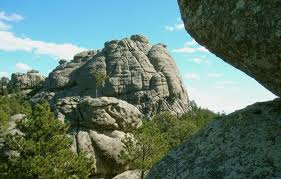
Baldy is one of the highest points between the Rockies and
the Alps. Death Crevice is on the opposite side of this image.
(We once climbed down the steep front face of Baldy; we
have never climbed up from that side.)
A few nights ago I put in a DVD and settled in to watch “127 Hours,” a true-life saga that – like everyone who sees it – I already knew the ending of: Canyoneer Aron Ralston, trapped by the untimely slippage of a boulder while exploring a red rock crevice in Utah, is driven to free himself by amputating his own right arm.

As the movie progressed, I became more and more tense until, just as Ralston came to the full realization of his predicament, I had to turn it off. I stopped watching not so much because I dreaded the anatomical gore that was to come, but because an existential, organic tingle started to radiate through my body – a kind of physical memory – reminding me of the cliffs and crevices of my youth, and of the various boulders that hung lodged in them, who knows how precariously.  And it’s not that I remembered how frightened I was in those situations – but that I, in fact, was having the time of my life. Like Ralston.

I was never the taut, conditioned, or skillful rock-climber depicted in the film, but I am ever grateful for the fact that, from the time I was twelve years old, when my family moved to the Black Hills, I have had rocks to climb. My cinematic cold feet were caused by the sixty-five-year-old me looking back on the literally carefree exploits of the twelve- and seventeen- and twenty-year-old me and… well, sort of watching a movie of myself descending into a crevice.

Which is not to say that those days are behind me. “Carefree” has perhaps been replaced by “careful,” (and “decrepit?”), but there are still rocks in my life – and even crevices. Like Death Crevice.

Baldy Mountain, a grand granite dome in the middle of the Black Hills, is laced with crevices. When you’re nineteen or twenty, as Jeff and I were then, you’ve got to try them all. You just plunge in and see where they lead – at least Jeff does, and so here I come, too. The final, upper reach of Baldy's summit -- after an initial approach up more gradual flanks -- thrusts almost straight up out of a grassy, alpine-like valley floor. We looked up the sheer but slightly rounded wall and spotted a ledge about forty feet up that was interrupted by a vertical crevice continuing up toward the top of the dome. To get to the crevice we had to get to the ledge; to get to the ledge we took a short running leap from the valley floor and used momentum and a few scattered, knobby holds, and the soles of our tennis shoes (we hadn’t yet discovered the wonder of Vibram), to scramble up the forty feet of granite. At least Jeff did – so here I come, too. The ledge was so narrow that the shallow crevice we leaned into felt like safe harbor. It was just deep enough, and angled enough, that it was a pretty easy knee-and-toe ascent to its upper reaches, where it opened onto an intersection with another crevice – actually a gap where one slab of mountain leaned against another – criss-crossing at a right angle. To continue upward (always upward!), it was necessary to leap or step across this gap and throw ourselves into the waiting maw of another crevice which continued up – now steeper and deeper – on the other side. A crevice we knew not the ending of.

Now, dear reader, you can join me in my imaginative remembering of this venture.  Go to the nearest wall and stand about four or five feet away from it. Keeping your feet together, lean toward the wall with your outstretched arms. When you make contact, step across the intervening space with one foot, then bring the other over. Then do the exercise again, this time, when you are leaning across the space with your hands against the wall, look down at the carpet and imagine that instead it is blue sky. You will likely come to two conclusions: One, this step is no big deal; two, if you don’t successfully make this easy step you could – you just could – plummet to your death.  Thus was born, in our breathless, adrenaline-fueled excitement, the name “Death Crevice.” The first time we leaned across, no doubt in mid-step, one of us probably said, “You know, a guy could die here.” I’m surprised that our sophomoric wit didn’t come up with “Theoretical Death Crevice.”
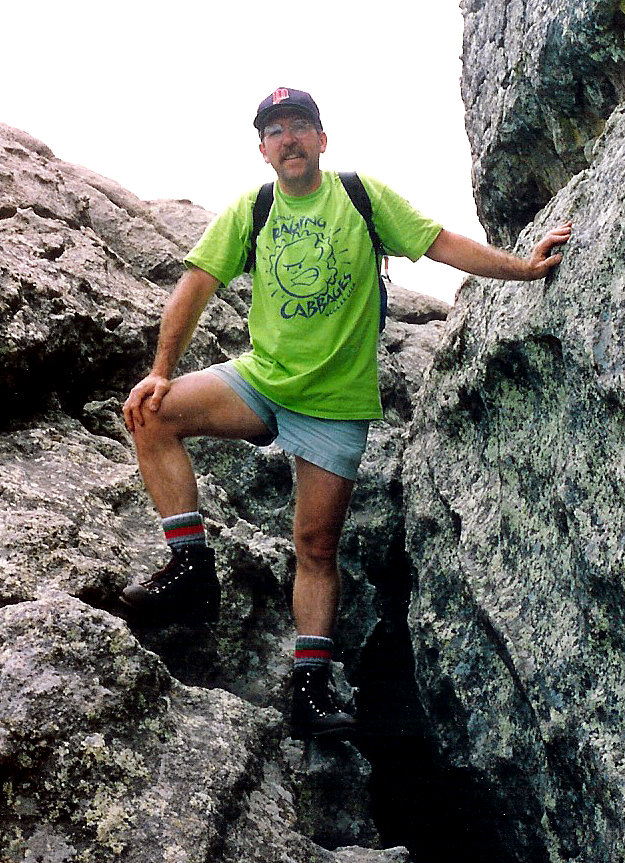
Jeff, emerging from Death Crevice, 1992
The crevice we entered on the other side of the gap is probably the most fun and just-challenging-enough climb of the dozens that Jeff and I have taken together over the years: the perfect dimensions for shouldering in some places, spanning from one’s back to the  tips of ones toes in others. Although once one was jammed in the crevice a fall wouldn’t mean death, you would get pretty banged up as you slid down, stopping just short of that blue-sky opening at the bottom. (Death Crevice has been known to dislocate joints.) It’s always fun, and that initial step-across-nothing is always a thrill.

To our delight, Death Crevice opened onto one more ledge, one more (easier) crevice, and the top of Baldy! Since that initial ascent, we have led many friends up Death Crevice. We've climbed it with our wives and kids. I look forward to doing it again soon. Well, let me clarify: Jeff takes them up Death Crevice, I volunteer to lead others up another one of our discoveries, a route we have named “Life Affirming Crevice.” No 127 Hours in there.
__________________________________________________________________
(What made me shudder at watching the movie was not recalling my climbs with Jeff – it was recalling the few times when, like the film’s hero, I tried it alone.)

Monday, January 2, 2012

THE TIDE'S PENDULUM TRUTH


…I have been made free
by the tide’s pendulum truth
that the heart that is low now
will be at the full tomorrow.
                                     ~R.S. Thomas


All of man’s problems come from his inability to sit quietly in a room alone.
                                                                                          ~Blaise Pascal

In the movie Topsy-Turvy – a depiction of the Victorian-era partnership of Gilbert and Sullivan –  there is a scene in which Gilbert has just had a recently-invented telephone installed in his home. His elderly father objects to it as an intrusion, complaining, “Why should I have a gadget that allows a stranger to set off a bell in my home whenever he feels like it!” I can’t think of a better summary introduction to the world of noise that ensued. With the invention of the radio at approximately the same time, our grandparents’, parents’, and now our generation have not only been present at the creation, but have observed the steady marginalization of quiet and solitude over the last hundred years. Quietness has, almost literally, been pushed to the edges of our existence.

Although the increasing number of noisy gadgets in our lives (including mine) should perhaps give us pause, my intention here is not to rail against them, but to offer a modest proposal for how to live with them in such a way that we experience a life of balance, benefiting from both the technology that we have come to require and the solitude that we, actually, need.

The proposal I have in mind is the Sabbath, or, more exactly, the idea of the Sabbath. While I am a proponent of the biblical Sabbath pattern of six days of work and one of rest, I am speaking here more of the micro- and macro-Sabbaths that flow from this principle.  (The Sabbath principle is one of those things about which it can be said, “It’s not true because it’s in the Bible; it’s in the Bible because it’s true.”) Sabbath means a number of things, but at its heart it primarily means “rhythm” and “rest.” It is “all work and no play makes Jack a dull boy.” It is why workaholism should be confessed and treated, not bragged about. It is why, when the boss bragged, “I don’t need a vacation,” one of his employees whispered, “He doesn’t think he needs a vacation but everyone else thinks he needs a vacation!” It is why Jesus said to the exhausted disciples, “Come away by yourselves to a quiet place.”

And it is why we need quiet after the noise of TV and cellphones, and darkness after the screenlight of iPads and Androids. It is rhythm, Sabbath rhythm. And it is rest – not, in this case, idle snoozing (although studies have shown that the afternoon nap is more productive, even in a business sense, than the afternoon coffee break), but the break from routine. Putting away the pale-lit device and talking across the table to a friend. Walking around the block. Sitting in church without texting.

If the irritating jingly bell represented the new intrusion of technology for W.S. Gilbert’s father, I suppose the icon for our current distractions is the familiar scene of two people talking, at least one of them bobbing his head nervously up and down, constantly checking the tiny screen that can’t be turned off – ever.

The always-on screen is a good modern representation of what the Bible calls the sin of failing to enter into one’s Sabbath rest. The non-sabbatical, always-on life – whether that of work or technology – is, like all sin, “not just bad – it’s bad for you.”*

The noise of devices and the glare of screens affects our brains, our relationships, and our attention. (Brain development needs down-time.) Everybody gets nervous if they see a driver heading toward them with a cell phone in hand, but the same everybody thinks that they are the exception who can handle it themselves. It is not just that the seventeen-year-old pickup truck driver – who killed a grandmother, mother, and daughter because he was texting – needed a sabbatical break from the screen; his victims needed him to take one, too. So much for the libertarian freedom of the cell phone.

The original sin was the sin of self-centeredness. (“I don’t need God, I can be God!”) It is still what all sin is. Our devices become like Eden’s talking snake, enticing us, “You can do it – and that, too, and that, too…, whatever you want…, these iThings are extensions of you! Why would you turn them off?”  And, to switch literary references, a picture of the Queen dancing in her iron shoes comes to mind. Dancing to death.

I am a user of these devices. Whenever I switch them off and sit quietly in a room or stare out a window or walk iPhone-free, the first thought I have is how good it feels. The second is how rarely I do this.

I was going to say that the margins to which quiet has been pushed are out in the woods – in the mountains – and that you can seek solitude in a backpacker's tent or a remote cabin. But that’s not really true, is it? If you approach all but the remotest cabin in the darkness you will see the soft blue glow of an iPad emanating from the picturesque windows. The real Sabbath – and the real Sabbath rhythm – is produced by an on-off switch (wherever you are), and by the solitude or conversation that follows.

When we read the most profound of the Bible’s many creation accounts – the one in the first chapter of Genesis – we see that the Crown of Creation is not humankind. It is not even God. It is the Sabbath.

______________________________________________________________
This New York Times essay by Pico Iyer (the source of the Blaise Pascal quote, above) is a very insightful and even inspiring treatment of this topic.

*"Sin" is kind of a loaded word for some; think "brokenness," or anything that works agains the fullness of life.

Thursday, December 22, 2011

RAGS AND TATTERS: SOME ROUGH LINES AT CHRISTMAS


Many preachers are confronted with a kind of awe at the great texts of Christmas and Easter, saying to ourselves, "What more can I say about so profound a story?" For a number of years my response to this has been to attempt a Christmas sermon in verse. I offer this one as my blog Christmas card.

Now Advent winds are bringing in the cold of winter,
and scattered stars glow with a chill and distant light.
The road to Bethlehem is getting ever darker –
and darker still before we come to Christmas Night.

Imagine, then, young Mary and her steadfast Joseph;
with little donkey clopping out a lonesome song,
she nods to dream, the child stirs, and she remembers
the message of an angel, now it seems so long

ago –  to her, and to the people of the promise.                                              
Her people have been waiting for these thousand years,
and she – for these nine months in which all time is folded –
has held all love: The answer to all hopes and fears.

Joseph’s hope, for now, is just to find that small inn,
a welcome place he’s heard of on the edge of town.
She’s tired and she’s cold – and soon they’ll be a family!
He’ll tell them, “Please, a bed so Mary can lie down….”

We, too, would add our voices after Joseph’s pleading,
“This is God’s mother – surely you can find a bed!”
But, no, God’s family comes this night in rags and tatters;
they’re lucky, after all, to get this straw instead.

And down through all the ages are so many searching,
like this poor young couple, as they seek to find
shelter, food, and friendship – and a new beginning:
A light ahead, the sad and weary road behind.

And even in our day of marvels, comfort, plenty;
chance can find a man, like that one you saw
homeless in the darkness as the winter gathers.
He, too, would welcome happily a bed of straw.

In Africa a mother’s life is much like Mary’s:
Gathering wood and water to get through each day.
Her Joseph on the road seeking work or barter,
as satellites spin on their high and starry way.

Our brothers in Colombia still live with danger –
like Israel’s people living in the grip of Rome.
This world, though history’s pages tell of many changes,
is still the world where Jesus’ family made their home.

The people in the darkness long to see that great light
promised long ago. So where is God to be
found? How will he save the people from their sorrow?
Will He work a wonder? Or is it that he

himself will be the miracle: God born among us,
not in golden wealth, but in that family –
Remember? – We were following them? They found a stable --
Look, there in that manger, could it… could it be…

A baby! Look! Here come a band of curious shepherds;
this is what the angel told them they would see.
This is why the heavens opened wide with glory
The savior of the nations is… a poor baby!

Rejoicing all around from these rowdy shepherds!
They tell their news to Mary, her eyes glow with tears.
In her heart she ponders all these words, and wonders
what life will bring their precious child down the years.

And, pondering, remembers her own angel’s message –
So filled with joy, and yet there was a shadow, too.
A son of mine?  To be the savior of the people?
Too much! But let it be: he’ll do what God must do.

And Joseph of the true heart will adopt this baby;
for love of Mary he will dearly love their child.
“Emmanuel” “God With Us” – Names the angel gave him –
but papa now must guard him in a world so wild.

Now see! Those cold and distant stars begin to gather
into a band of light and they bow to one:
One star among them shines a beam of love’s own brightness
upon the little scene: The birth of God’s own son!

And you, who like the shepherds, now have heard the good news,
like them you’ve heard what Heaven’s angels had to say,
now join your voice to theirs: shepherds, stars, and angels,
And sing that Jesus Christ the Lord is born today!


____________________________________________________________
References to Africa and Colombia are a recognition of our congregation's companion churches in those places.