Sunday, July 21, 2019

APOLLO 11: "The world all stopped to watch it..."

The Moon and the humanitarian patriotism of John Stewart’s Americana
Oh, Mother Country, I do love you…


From the somewhat unlikely cocoon of The Kingston Trio, John Stewart (not to be confused with comedian “Jon”) emerged in the late 1960s to become one of the preeminent songwriters* in the movement that has come to be labeled “Americana.” Although it’s true that, in many ways, Americana can be considered just another word for “folk music,” there is a subtle distinction in its meaning, and it is especially appropriate as applied to the songs of John Stewart. At a time (maddeningly reminiscent of current days) when bumper stickers blared “America — love it or leave it!,” Stewart — who toured with Robert Kennedy’s final campaign — wrote of a heartfelt and unabashed love for America based not on waving flags but waving wheatfields, and the promise and possibilities of wind-swept prairies and wind-weathered people. (“Wind” was one of his favorite images.)**
Caryl and I grew up on those prairies. In the spring of 1969, having graduated together from our midwestern college (we were married the following December), we headed west to spend the summer in my home town, Rapid City, South Dakota, looking forward to one of our favorite pursuits: driving aimlessly through the backroads and valleys of the Black Hills, stopping here and there to attempt to find our way up a mildly-challenging granite crevice. And those backroads and mountain curves were always accompanied by music. In a time when one could still make a discovery by flipping through music store bins, I was doing just that at Haggerty’s in Rapid City when I found John Stewart’s album (in cassette form) — “California Bloodlines.” I recognized Stewart from the Kingston Trio days (I’m afraid I was a KT nerd), and snapped it up. It became the soundtrack of our summer. And, it turns out, not just ours…


Even more memorable — in that summer of 1969 — than discovering John Stewart’s music was sitting in my parents’ living room on July 20 watching the landing of Apollo 11’s lunar module, with Armstrong and Aldrin’s momentous walk. And so, a segue and an aside: I have eagerly viewed many of the movies and documentaries released in anticipation of the 50th anniversary of the launch. (That’s today! — as I write.) The best, in my opinion, and the one I suggest if you are going to watch just one, is the CNN Films documentary, “Apollo 11.” I learned many things watching that film, one of which is that Buzz Aldrin had also just discovered John Stewart! Stewart’s “Mother Country” (from “California Bloodlines”) was on Aldrin’s “mix-tape” and was playing in the Command Module as they headed back to Earth. The documentary film-makers heard this in the background of some archival footage, and included the song in the movie’s soundtrack.
“You know, there was just a lot of people
Who were doin’ the best they could.”
The good old days…
Were just a lot of people doin’ the best they could.
And they did it pretty up and walkin’ good!
Oh, mother country, I do love you.
The “Mother Country” on Aldrin’s tape was not about space flight, but about a kind of American spirit exhibited in historical situations like the Johnstown Flood. The film-makers edited the lyrics for use in the soundtrack. You can hear Stewart’s whole song here: “Mother Country.
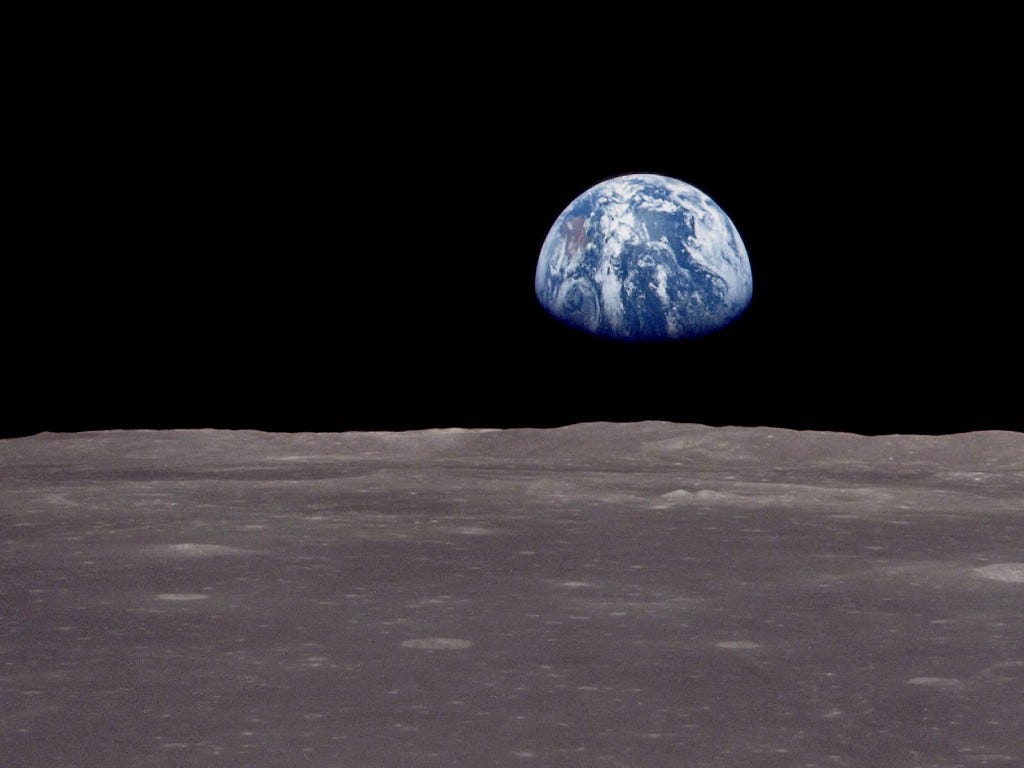
A few years later, Stewart did, in fact, record a song about Apollo 11 — as an experience not just for America but for Earth. “Armstrong” is a lump-in-the-throat ode to humanity’s achievement of reaching the Moon, and, at the same time, a pensive reflection on the lives of those left behind as the Saturn rocket blasted skyward. The song, while marveling at what has been done, is not proclaiming “We’re number one!” but rather, as has often been remarked about the famous image of the Earth from the moon, “We’re all in this together.”
On this anniversary occasion, I hope you will listen to John Stewart’s rendition of this thoughtful song, “Armstrong.” I close this homage to that day, those guys, and John Stewart, by including his complete lyrics.
Black boy in Chicago
Playing in the street;
Not enough to wear,
Not near enough to eat.
Don’t you know he saw it
On a July afternoon — 
Saw a man named Armstrong
Walk upon the moon.
Young girl in Calcutta
Barely eight years old;
Flies that swarm the market place
Will see she don’t get old.
Don’t you know she heard it
On that July afternoon — 
Heard a man named Armstrong
Had walked upon the moon.
Rivers are getting dirty,
The wind is getting bad;
War and hate are killing off
The only earth we have.
But the world all stopped to watch it
On that July afternoon — 
Watched a man named Armstrong
Walk upon the moon
And I wonder if a long time ago,
Somewhere in the universe,
They watched a man named Adam
Walk upon the earth.

____________________________________________________
*Preeminent, but perhaps you’ve never heard of John Stewart. He was a “songwriters’ songwriter.” His own albums are classics of Americana and folk, yet always stopped short of actual fame. (The Rolling Stone named “California Bloodlines” one of the 200 most important albums of all time.) The Monkee’s made a hit of his “Daydream Believer,” and Roseanne Cash recorded his “Runaway Train.” Stewart died in 2008, at the age of 68.
**I wrote about John Stewart’s ballad of a midwestern childhood, “The Pirates of Stone County Road,” here.

Saturday, March 23, 2019

THE CONSOLATIONS--AND ODD CONTEXTS--OF POETRY

As related in his gripping true-life tale in the New York Times Magazine, the author, Jon Mooallem, was faced with an episode of not-knowing-what-to-say that makes my experiences of that uncomfortable phenomenon seem trivial. (The following slight hint of a spoiler will not detract from your enjoyment of the yarn.) He was pretty sure that he had to keep talking in order to keep his friend alive. And talking… and talking… for almost two hours, awaiting a rescue that was anything but certain. But what to say? After exhausting his store of platitudes—What to say?

He said poetry. Mooallem reports his gratitude to two college professors who made him memorize poetry. And so, there on the forest floor, he recited poems to his friend. Nature poems, comic poems, mystical poems. Love poems! Elizabeth Bishop, WH Auden, Robert Frost, AR Ammons, Richard Wilbur. “For the most part,” he says, “I trafficked in hits.” 

(With the author, I’m grateful that he could recall his poetic “hits," but it also caused me a bit of mild regret. I, too, had teachers who encouraged the memorization of poetry; but if I were to find myself in a similar situation, I could maybe muster three or four, with a few snippets thrown in. And I read poetry every day.)

Mooallem’s account reminded me of another nearly-doomed adventure: The 1907 Shackleton Antarctic Expedition. As the Endurance was being crushed in the ice, the crew rescued what they could from their sinking ship and scrambled on to an ice floe—adrift in the middle of the Weddell Sea—where, after checking to see that all had survived, and getting situated on their floating home, Shackleton read poetry to them. Not memorized, but read from one of the many volumes rescued from the library of the sinking ship.
The sinking of the Endurance
Priorities! If the reader is moved to exclaim, “What?! Poetry?! There on the ice floe?!,” it is well to recall that the expedition didn’t lose a man in the three-year ordeal, of which the sinking of the Endurance was just the beginning. Historians give the credit to the leadership of the poetry-loving Shackleton.*

The late U.S. Poet Laureate Donald Hall said, “Poetry is the language used at its best.” Although, for many, “poetry” means a breezy recitation of facile, sing-songy rhymes—either silly or maudlin—it is actually the deepest language of life, death, love, purpose, hope, and mystery. The reason that the Twenty-Third Psalm is one of the most beloved passages of scripture (and literature) for the last three thousand years is not because it’s beautiful (which it is), not because it speaks the truth about life and death (which it does), but because it’s poetry--the language used at its best—and most truthful. (I bemoan the literalism of those of the “Evangelical” church who limit the Bible by not allowing much of it to be the poetry that it is.) Author Mooallem could have said to his friend, “Hang in there, man.” Ernest Shackleton could have said, “Buck up, boys!” The Psalmist could have written, “Hey—everything’s going to be all right.” But they didn’t. They used poetry.

There are different versions of poetry. As a pastor, I sometimes hear—from an elderly parishioner whose eyesight is dimming—“I’m glad I know that hymn by memory.” One of the members I visit in the parish I’m serving in retirement is deeply into Alzheimer’s—often expressing confusion or even belligerence. I asked her daughter if she could suggest ways I might try to reach her mom. “She likes hymns,” she said. On my next visit, I didn’t say too much, but I sang “Beautiful Savior.” My elderly friend quieted down, her eyes calmed, and her lips were moving silently with the words.

I really do regret not memorizing more poetry, but—considering these variations—I think I could actually keep a friend awake for two hours with a combination of folk songs and old hymns. By which time, no doubt, he’d be very happy to see the rescue crew coming through the trees.

______________________________
*One of the last books I read which merits the saying, "I couldn't put it down," is Roland Huntford's "Shackleton."

And, on the pure fun of reading poetry out loud: "Cargoes of Diamonds, Emeralds, and... Snipping Snoppers?"

Wednesday, January 23, 2019

MORE TEAKETTLE, MAESTRO?

After forty years of coming home from a day of teaching to face the immediate challenge of putting supper on the table for our family, Caryl was only too happy to relinquish that task—about ten years ago—when I took to cooking as kind of a hobby. Now in retirement, I find it very satisfying to see her actually sitting down, reading or working a crossword, while I busy myself in the kitchen.

For me, one of the best parts of fixing a meal is listening to music while I’m cooking. And it has to be loud, or, should I say, of appropriate volume. My theory is that the music
My little Sony kitchen speakers can really
pump out the sound!
coming from the set of Sony bookcase speakers that I’ve put in the space above the kitchen cabinets should be at least as loud as what one would hear in a symphony hall or honky-tonk bar. 

One day last week I had just downloaded a new recording of Dmitri Shostakovich’s Eleventh Symphony and was using my supper prep time for its first listen. I punched “play” on my iPhone music app, and as the tremendous sounds of the Eleventh filled the kitchen with the cacophony of the 1905 Russian Revolution, I turned to my cutting board. As the music built in tension and sonority, I set my knife down and turned up the volume just a bit. My eyes might even have been glistening a little to the thrill of it all, when my reverie was rudely interrupted: Caryl, standing in the doorway, finger poked in the page of the book she was holding, “Does it have to be so loud?!” she shouted. I started to reply, “Have I ever told you my theory about how music should be loud enough…,” “WHAT?...” she shouted, cupping her ear. “MY THEORY…” I started again. “Oh, never mind, “ I said in something of a huff, “I can listen on my headphones.” (Despite my sweet, husbandly description, above, I actually didn’t realize that she was sitting in the next room, reading.)

Caryl returned to the living room and her book, I plugged in the headphones and turned again to the tasks of chopping, dicing, boiling water, and preparing the spices. The preparations were coming along nicely when Shostakovich got to the great second movement, the Allegro: “The Ninth of January.” That rapid, repeating gunfire assault: Staccato snare drums at full volume! The shrieking violins were the screams of the innocent protesters under attack. Once again, I put down my ladle and stared off into a kind of musical-historical haze. Once again, I was wrenched back into the now: Caryl, at the doorway: “WHAT IN THE WORLD…?!!!”

“But,” I started to say, “I’m wearing my headpho…” when, at that instant, I became aware that the teakettle was fuming at full steam about eighteen inches away from me. In that same instant, I realized that it had been screeching at full throat for about three minutes! “WHAT IN THE WORLD…?!!!”

“Oh, sorry,” I said, as I took off the headphones and removed the kettle from the heat. And then I explained, “You know what’s funny? It’s not that I didn’t hear the teakettle. I heard it—and I thought it was part of the symphony! It fit right in! Pretty funny, huh?”  Then we both had a good laugh. At least I think Caryl was laughing as she turned once again into the living room. I know I saw her head shaking.

In my defense, dear Reader, I urge you to listen to this movement, the Allegro from the Shostakovich 11th. If you want to get right to it, you can start at about minute 14. But you must listen loud—loud enough so that a tea kettle at full throttle will sound like part of the ensemble, subtle as a flute.
_____________________________________________________________

Dmitri Shostakovich, 1906~1975


Saturday, January 12, 2019

TALKING TO MYSELF

In 1976, the late Princeton psychologist Julian Jaynes published a book whose title summarizes his theory: “The Origin of Consciousness in the Breakdown of the Bicameral Mind.” My co-discoverer Jeff and I have kept this book on our shelves just because of our affection for the wacky title, but the theory, though now somewhat scientifically discredited, was not wacky. Three of its major components are 1) That before about 1000 BC (the time of classical Greek ascendency and Hebrew covenantal monotheism), humans, instead of being automatically conscious of their intentions and behaviors, were activated by a process in which one hemisphere of the divided (“bicameral”) brain received messages from or took orders from the other hemisphere. An illustration from our own experience would be that, instead of automatically stepping on the brake pedal in a quickly developing emergency road situation, one would actually “hear” a command to “step on the brake;” and that, 2) The myth of the existence of “gods” developed from this experience of hearing commands dictating what  one was to do—commands emanating not from the heavens, but from the other side of one’s head; and, 3) consciousness (self-consciousness), thus, was an evolutionary development of language; language came before (and produced) consciousness—a process that came to significant transitional fruition around 1,000 BC, the time by which the severe division between the hemispheres had been “broken down,” resulting in the more smoothly automatic mental process we know today. (Of course the hemispherical division is still an important part of brain function and study—beyond the scope of this little essay.) 

Fast forward to 2019, where, in my little upstairs study, I’m reading about Cognitive Behavioral Therapy (and watching a terrific 20-part CBT lecture series from “The Great Courses”). I have been professionally interested in Cognitive Behavioral Therapy for a number of years, and, more recently, personally interested in it for the possibility that CBT could, perhaps, teach me a thing or two about myself, life, and relationships. (An aside: Similarly, I was very interested, professionally, in Family Systems Theory and its emphasis on the “Non-Anxious Presence” as an important part of healthy communication, when it dawned on me: “Hey! This could help me!”) But, back to CBT…

The three corners of the Cognitive Behavioral Therapy triangle are “Behavior,” “Thoughts” (or “beliefs”), and “Emotions” (or “feelings”). Each acts to affect the others. One overly-simple application would be the old Henny Youngman one-liner: “’Doc, it hurts when I do dat.’ ‘Don’t do dat!’” In the Therapy part of Cognitive Behavioral Therapy, the therapist helps the patient to see how her thoughts produce behavior and behavior produces emotions, and vice-versa—and provides strategies (and homework) to understand and take control of these three areas. A clinically proven offshoot of CBT, “Mindfulness-Based Cognitive Therapy” (MBCT), emphasizes the value of accepting—rather than wrestling with—one’s thoughts, and then moving beyond them. “You are more than your thoughts; you are more than your feelings.” Who are you?

Cognitive Behavioral Therapy is often prescribed for treatment of such conditions as depression, obsessive thoughts, and social anxiety.[1]But it has a very valuable usefulness in addressing the problems, behaviors, communication, and relationships of normal, everyday living. The behavioral psychologist Jonathan Haidt (author of “The Righteous Mind”[2]), writing in The Atlantic,[3]suggests that every incoming college freshman should be taught the principles of CBT because “it teaches thinking skills that people can continue to use.”

One of the thinking skills that my exposure to cognitive behavioral therapy has taught me is to simply acknowledge and be aware of the thoughts and feelings that come into my head, and to be consciously aware of how these thoughts and feelings affect my behavior—to be in control of them, that is, rather than mindlessly allowing these thoughts and feelings to drive me like a Disneyland autoanimatron. Once aware of them, I can take a breath, give myself a little talking-to (my mantra is “Uh-oh, time for an attitude adjustment”), and—to use a modern analogy—“re-boot” the situation, with “me”—rather than my feelings—in charge.

Two examples demonstrate the ordinariness of the kinds of situations in which this works for me:

1) Rounding the corner to approach the check-out area at IKEA, I see that every line has at least thirty people in it. As the old anxiety starts to bubble up, I actually recite that mantra (above) to myself, and the anxiety bubbles disappear almost instantly. And I may expand on the mantra by thinking, “This can be kind of a nice time.” Sometimes this results in my chatting up my fellow line-standers. I’m not sure how they feel about this, but it has to be more pleasant than standing next to a guy who’s rolling his eyes, fidgeting from foot to foot, repeatedly checking his watch, and sighing heavily. But the person who really benefits from this new approach is me! (And my blood pressure.)

2) Speaking of checking one’s watch: Arriving for an appointment in the clinic waiting room, I used to do an increasing slow burn for every five minutes beyond my appointed time, my anti-mantra being, “Hey, my time is valuable, too!” Then, into my life came CBT (just by reading about it), and I had myself a little talking-to: “Oh boy! More time to read my book!” Now, when the nurse appears, to summon me, I’m likely to say, “What, already?” 

Similarly, the great Family Systems therapist Edwin Friedman[4]points out that the words we choose to say (and how we say them) can either raise or lower the “anxiety temperature” in the room. Like this: Trying to avoid being late for a family wedding, a father can yell up the stairs to his teen-age daughter, “You get down here right now!” or, he can say, “How’s it going up there?... I think if you can be down in five minutes we’ll make it.” The importance of the difference between these two approaches is not the speed of the daughter’s preparation, but the emotional atmosphere in the car on the way to the wedding. Simple word choice! Takes about half-a-second to consider—to let yourself rather than your emotions be in charge of what you’re about to say. “It is you,” says the philosopher Goethe, “who makes the weather.”

I have no doubt I could benefit from a sit-down session with a certified cognitive behavioral therapist, but simply learning about these principles, which are profound but are not rocket science, can effect significant changes, producing (to quote Dr. Haidt once again), “thinking skills that people can continue to use.”

One final example. A couple of days ago I was driving from my home to the next town over for a weekly gathering of friends. The car ahead of me had the effrontery to be going the speed limit. (He was apparently unaware of that mysterious ordinance that says the actual speed limit is the posted number + 5.) As I craned my neck to check the passing lane, my foot beginning to press on the accelerator, I suddenly heard a voice inside my head saying, “Where are you going in such a hurry?” My response was to physically relax and think, “Yeah, why such a hurry?” And I backed off, anxiety gone.

This was no studied mantra, but something like a voice. Inside my head. Either those CBT "thinking skills" are becoming automatic--or the bicameral mind has not completely broken down after all!


~In Memoriam, Julian Jaynes, 1920-1997~


[1]“Cognitive behavioral therapy is the most extensively studied nonpharmaceutical treatment of mental illness, and is used widely to treat depression, anxiety disorders, eating disorders, and addiction. It can even be of help to schizophrenics. No other form of psychotherapy has been shown to work for a broader range of problems. Studies have generally found that it is as effective as antidepressant drugs (such as Prozac) in the treatment of anxiety and depression. The therapy is relatively quick and easy to learn; after a few months of training, many patients can do it on their own. Unlike drugs, cognitive behavioral therapy keeps working long after treatment is stopped, because it teaches thinking skills that people can continue to use.” ~Jonathan Haidt, writing in The Atlantic (see footnote 3)

[2]Run, don’t walk, to read this book. It will change the way you think about almost everything. Or, as the NY Times book reviewer put it, it is “a landmark contribution to humanity’s understanding of itself.”

[3]The Atlantic magazine, September, 2015.

[4]  Friedman’s book, “Generation to Generation,” is written for therapists and counselors, but the first third of the book is a very good (and readable) introduction to “family systems theory,” including the highly important concept of the “non-anxious presence.”

This Web site is a pretty good overview of Cognitive Behavioral Therapy.

Thursday, December 27, 2018

DECEMBER 27th (for Caryl)

Here on the forty-ninth anniversary of the years
that are our years
you are downstairs at the piano
and I’m up here in this garret, at other keys,
trying to wrest the Good News into my annual doggerel
for the First Sunday of Christmas.
Because—as with that startling announcement to the shepherds—
it must be poetry. And it must be music.
“Glory to God in the highest…”

“Let there be spaces between your togetherness…”
said our 60’s prophet Gibran.
So I’m up here—you’re down there.
Good Spaces.
But not so far apart that I can’t hear your glissandos
wafting up the stairs, teasing my leaden verse into life.
The Word become flesh.
The morning stars singing together for joy.
Word. Singing. Joy.

Christmas Eve was kids, grandkids, a dog!
Words, Singing, Joy!
Now they’ve gone—north, south, east…
And, on the very date of our 49thyear,
just you and me.

I’m going to bring what’s left of this bourbon-and-tonic,
come down that glissando stairway,
sit in that orange chair by the piano,
and listen to you play.


Friday, June 29, 2018

On Discovering That My Room Divider Was Unhooked

I have one of those beaded bamboo curtains
hanging in the doorless doorway
to my small study.
“Hanging,” I say, except that , for months, I’ve had it
hooked back on each side
so as not to make that click-clack every time I come in.
Just now I approached to find it
unhooked, vertical, hanging—swaying
with an almost imperceptible motion.
It was the vertical—and that slight, breeze-like sway—
that caused me to pause
before walking through it.

“Violet’s been here,” I thought.
It’s as though she had discovered the door
to Lewis’ Wardrobe
and might be somewhere inside.
I pushed through the beads. CLICK-CLACK,
Click-Clack, click clack.
click.

Isn’t that why I installed it in the first place?
To keep the world outside,
And to let Violet, and me, into Narnia?
Click-Clack.


Saturday, March 3, 2018

HOW MUCH IS TOO MUCH? or... MAYBE I NEED A CHAINED REMOTE

A while back I heard a beautiful overture by the British Composer Edward Elgar, played on the classical music station of Minnesota Public Radio. At the conclusion of the piece, the announcer mentioned that the work had its premiere at “an English country fair” in 1890. That simple announcement got me to pondering: For the great majority of those who heard Elgar’s overture that day at the fair, this was the one and only opportunity they would have to do so. It’s not impossible that a very few were able to hear it again, perhaps in a London concert a few months or years later, but only a very few, if any. And none would have had access to the precursor of the radio I was listening to; the first tenuous radio broadcast was fifteen years in the future. If a music lover at that English country fair that day found the piece to be yearningly beautiful, that’s all she was left with: yearning.

I heard the Elgar piece because I can listen to classical music any hour of the day or night. If I find a piece to be yearningly beautiful, I click on iTunes or Amazon and order it as a CD or MP3, so it is then available whenever I desire. I wouldn’t trade places with the country fair-goer, but it is not unreasonable to wonder which of us had the deeper aesthetic experience. As Orson Welles said, “The enemy of art is the absence of limitations.”

The Chained Library at Hereford Cathedral
A few years ago, Caryl and I worshiped at Hereford Cathedral in England. After church, we toured the “Chained Library.” The Cathedral has had a working theological library since the twelfth century; the literal chaining of the books was simply a medieval security system. (Especially before—and even after—the invention of the printing press, a purloined book would be impossible to replace.) I love arranging and rearranging the volumes in my little library—and adding books with a frequency that requires some creative shelving. As with my musical “library,” I have hundreds of books within easy reach even here in my 12’ x 15’ study, and any title I want is available at my wonderful local bookstore or its online site. (Amazon as a last resort!) But I wish I had the imagination to inhabit the
A corner of what I like to call "My Library."
mind of a medieval cleric as he pulls a single leather-bound book out of the stacks--
backwards, so that the chain doesn’t twist--and the book lands open in his hands. (And I think I’m a book-lover?!)


I am of the generation that, in childhood, had to get out of the chair and walk across the room to change the TV dial to one of three channels, depending on whether we wanted to watch Maverick or Sky King or Disneyland or Captain 11. I am not nostalgic about this. (Well, maybe a little.) I mention it because we recently “cut the cable” for the opposite reason: We were paying for 800 channels and watching only three (okay, seven) of them. Now, with Roku and Spectrum and Netflix and Amazon and Broadway HD, we are unchained from the 800, and free to choose among the really good programs on the streaming channels. Really, really good. Our new complaint/mantra is “Too much good TV!” If we add the PBS programming that Caryl and I have watched every Sunday night (and now Friday and Saturday) for forty-eight years--and the programs of other networks included in these packages--to the offerings on our new streaming services, here is a partial, random, list of really, really good TV that we are watching now, or can get to on TiVo, or find with the juggling of two remotes: Masterpiece (currently, Victoria), Sherlock, Father Brown, The Amazing Mrs. Meisel, Stranger Things, The Queen, Call the Midwife(!), Crashing, This Old House, 800 Words, Vera, Last Tango In Halifax(!), Monarch of the Glen, Nashville, Grantchester, Curb Your Enthusiasm, The Hollow Crown(!), Colbert, Conan, Highway Through Hell (my one guilty secret reality show!), Nature, Nova, Frontline, American Experience, the new Broadway musical adaptations of Wind in the Willows and From Here to Eternity, many HBO offerings, and more. (Let the judging of our TV tastes begin—certainly l’ve left off your favorite program.)


TV test pattern used for sign-off at midnight.
Good luck trying to binge-watch Stranger Things!

Speaking of HBO, Caryl and I nodded in agreement when we first heard, “HBO is the new Hollywood.” (HBO’s “Deadwood,” described by my demure wife as “Shakespeare with the F word,” is still the best thing ever shown on TV.) HBO was followed by Netflix Productions and Amazon Originals and Hulu… Now they’re all New Hollywood, and, mostly, excellent. Not to mention the regular “old Hollywood “ flicks that are included in their offerings. The memory of standing in a line that ran around the corner—to see Spartacus at the Elks Theater in Rapid City in 1962—fades as I pick up the remote to watch it again on Netflix.

A predictable conclusion to these musings would be to look back in the spirit of what we English majors call ubi sunt (“Where are they now—the old simplicities of yesterday?...”), to plead for the return of the three-channel Crosley Television Set in the living room, to look back in longing at that English country fair—to be sitting under a tree with a picnic basket, a Victorian orchestra serenading the scene. But that is not the conclusion I draw from these observations of history and progress. It is rather to raise again the question that accompanies all progress: “What have we gained, and what have we lost?” I make no attempt at a complete answer to this question, but the question itself helps us to temper our excitement with the new by setting it in the context of another question: “What makes for a good life?” It might sound wishy-washy to say that the good life must be found somewhere along a spectrum which includes a solitary country symphony concert on the one end and an iPhone with a thousand MP3s on the other. This is undoubtedly too mathematical a scale to judge matters of art and the heart, but it invites us to consider and apply an idea that has accompanied and tempered all progress: The Golden Mean. The answer to the good life question is neither “the olden days,” nor “anything new!” but a learning-from-the-old, and an adaptation of the new to a standard set by common sense, a balanced personal life, and supportive relationships. I don’t need to give up my iPhone and all its apps, but I also need to remember, as Sherry Turkle reports, that an iPhone at the dinner table—even turned off and upside-down—is an intrusion into the flow (and feel) of conversation and the connections of the lives around that table. The Golden Mean.

So now that we have nothing but quality TV and a home collection of classical music, perhaps we are not (in the words of Neil Postman’s cogent title) “amusing ourselves to death.” (“Hey, I’m watching Shakespeare here! I’m listening to that Elgar overture again!”), but could it be that we are enlightening ourselves to death? The quantity of high-quality television shows—of which my list, above, is a small percentage—reminds me of that truism about visiting the Smithsonian in Washington, D.C.: If a visitor spends a minute at each display, he will not make it through the museum in his lifetime. 

This essay was sparked by that TV program list, which I started for a personal project of cutting down on some of this excellent TV-watching—limiting it for the sake of a balanced life and recovered time. If I cut some of it out, I’ll have a better answer to Caryl’s question, as she steps into my little library: “Are you ever going to read all of these books?”