Showing posts with label children. Show all posts

Friday, June 29, 2018

On Discovering That My Room Divider Was Unhooked

I have one of those beaded bamboo curtains
hanging in the doorless doorway
to my small study.
“Hanging,” I say, except that , for months, I’ve had it
hooked back on each side
so as not to make that click-clack every time I come in.
Just now I approached to find it
unhooked, vertical, hanging—swaying
with an almost imperceptible motion.
It was the vertical—and that slight, breeze-like sway—
that caused me to pause
before walking through it.

“Violet’s been here,” I thought.
It’s as though she had discovered the door
to Lewis’ Wardrobe
and might be somewhere inside.
I pushed through the beads. CLICK-CLACK,
Click-Clack, click clack.
click.

Isn’t that why I installed it in the first place?
To keep the world outside,
And to let Violet, and me, into Narnia?
Click-Clack.


Wednesday, March 22, 2017

HOW I WILL LOVE YOU

Our daughters, Beret and Anna, have become lovely women by the love of God and the gentle wisdom of their mother. February 17th is the anniversary of Anna's Arrival Day; March 22nd is Beret's Birthday. I wrote this many years ago for any parent preparing for the arrival of a child by birth or adoption. But, really, I wrote it for Beret and Anna.


HOW I WILL LOVE YOU

You will come through the miracle passage of birth
From somewhere in heaven to right here on earth –
Right here, where this family is waiting to start;
Right here – to these arms and this place in this heart.

Or maybe your journey will detour around
Till your own private angel-jet touches the ground,
And there I’ll be waiting to see who we’ll be,
And I’ll adopt you – and you’ll adopt me!

And how I will love you! When you are brand new!
When you are first finding out how to be you!

Of course you’ll be beautiful, handsome, and smart –
But that’s not the reason love grows in the heart.
You won’t have to earn it or prove it to me;
That’s just the way love is – love comes for free.

Free – but not easy – not every day;
Sometimes I won’t know just what I should say
When you are angry or tired or wild.
It’s then I will love you…
 Because you’re my child!

And every day you will grow just a bit,
And every day some more clothes will not fit.
All of that growing will take lots of food,
And of course it is my job to make sure it’s good!

And so we’ll have breakfasts and banquets and snacks,
And picnics with fortunate ants on our tracks.
But tables are more than just places to eat –
The family table is where you will meet…

…Uncles and aunties and grandmas and pas
And dozens of cousins who’ll love you because –  
Because you are family – because you are you,
And since they’re all family – you’ll love them too!

And how we will love you – as we watch you grow,
As you start to learn all of the things you will know.

And we’ll learn together! We’ll read lots of books;
You’ll soon know how all of the alphabet looks,
And how all those a’s  b’s  c’s and d’s sound.
Oh, how the words will go round and around!

Words in your eyes and words in your mouth,
Words flying east and west, words north and south.
Some words we’ll read in short stories and long,
Some words we’ll warble together – in song.

And how I will love you – as you sit in my lap
And we sing lullabies – till we both take a nap!

Then after our nap we will go out and play
Making up games for the rest of the day.
We’ll choo-choo with trains as we watch them go by,
We’ll stretch like the trees as we reach for the sky.

Some day, like the big kids, you’ll go off to school;
You’ll learn the latest grammatical rule.
Some day, but not yet. I’m glad that you’ll be
Still – for a while – right here with me.

And how I will love you when day turns to night,
And you hug your best blanket as we turn off the light.

Then I’ll sit by your bed and I’ll sing you to sleep,
Or I’ll try – ‘cause your plan will be that you’ll keep
Awake all night long and sleep all the next day
So the next night, again, you’ll be ready to play!

But finally you’ll fall asleep under a book;
I’ll turn at the door and I’ll sneak just a look.
You’ll be sweetly asleep, another day done,
And when you wake up you will be twenty-one!

I’ll think back and remember the first day you came,
And I’ll see that… you’re bigger! But, really, the same.
You’ll still be the one I loved right from the start –
All grown up! But always the child of my heart.  

And how I will love you …


I set out to write this as "How we will love you," but I wasn't smart enough to make the rhyme and the flow work that way.
Plus, I wanted it to speak for a single parent, too. But, for me, the "I' should be read to include both Caryl and me. Of course
Beret and Anna would agree.

(c) Richard Jorgensen

Sunday, March 30, 2014

GRANDMA OLIVE AND THE STRAWBERRY CIRCLE

I wish I were a poet. If I were, I could make something of this snippet that’s been running through my mind the last few days,

Grandpa, can I
Yes
Grandpa, will you
Yes
Grandpa, can we
Yes
Yes Yes Yes, my boy
Yes

That’s inspired by grandson Sam. A few days ago his almost-three-year-old sister, Violet, snuggled with her blanket in a chair and then said, “Grandpa, now I need a snack and my milky and my num-num” (pacifier—yes, yes, she’s being weaned). “Yes, princess,” I replied. Not a minute later she disensconced herself from her cozy throne and appeared in the kitchen doorway. “Grandpa, are you doing it?” “Yes, your majesty.” Of course it occurred to me that Violet’s parents would no doubt disapprove of both sides of that exchange. But I’m Grandpa.

As a parent, I was a slow learner in regard to grandparental rights, privileges, wisdom, and VALUE!, especially in regard to my mother-in-law, Olive Nasby. A few days before Beret (Sam and Violet’s mother) was born, Caryl told me that her mom was going to come and help out. “Gee,” I said, “I thought it would be nice to just be our own little family.” Beret was born; Olive came. After about ten minutes I was on my knees saying “Thank you, thank you, thank you!” (Of course now I understand that you moms might greet my quaint idea about doing it by ourselves with, “Easy for you to say, dad!”)

A year or so later we were visiting Caryl’s parents at their farm. Beret, now a toddler, was sitting in her highchair in Olive’s homey kitchen, and I had given her a big juicy strawberry, which sat, untouched, in the middle of the highchair tray. “Put a little sugar on it,” advised Olive. “No,” I said (I think my nose might have even raised itself a bit into the air), “no, we’re raising Beret without added sugar.” (For most of our daughters’ early childhoods I would sneak around the corner to put the tablespoon+ of sugar on my Cheerios—which I had grown up with—while they ate theirs sugar-free.). “Come on, “ repeated my mother-in-law, “try it with a little sugar.” “No thanks, “ I said. The conversation—and our attention—turned elsewhere. A few minutes later I noticed that the strawberry was gone. Where it had stood on the tray there was now only a small circle of sugar. (And a sweet strawberry blush circled Beret's mouth.) At that point I gave in completely to my mother-in-law.

And she treated me like a king. Absolutely every time we visited, I would open the refrigerator and there would be a brand new unopened pint of half-and-half, because she knew I liked it on my cereal. (I know there’s a kind of sugar-and-cream theme going on here, but we’re talking about the daughter and grandson of Norwegian immigrants.
Olive Nelson Nasby
Would you tangle with this woman?
)* And Beret's sister, Anna (who came along later), reminds me that it was for me--and not necessarily for them--that Grandma always had freshly made donuts ready at our arrival.

Olive is also the person who taught me not to fear death. But that’s another story for another time.

She is remembered in love. She rests in peace. Try a little sugar.


_____________________________________________________________
*I am aware of important recent reports about the dangers of too much sugar; Caryl and I have changed our habits somewhat, and try to help our grandkids with theirs. But this isn't a story about nutrition. (Although I should point out that the same studies have restored  to some degree the reputation of cream!)

Saturday, August 25, 2012

GRANDPA, WHAT...? GRANDPA, WHY...?


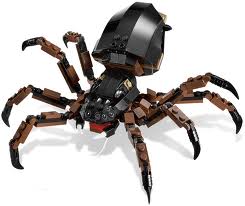
Lego's wonderfully articulated Shelob.
How did she become "evil?"

A little child shall lead them…

I find, alas, that I am in substantial agreement with the old saw, “There’s nothing more boring than other people’s grandchildren or vacation photos.” (There are exceptions, of course. Your grandchildren, for example, are certainly not boring. But I draw the line at your vacation pics.) So I will be neither offended nor surprised if – when I tell you that this essay is inspired by my grandson, Sam – you click off immediately as you stifle a yawn. But let me make this attempt to stay your hand: In what follows, I write not about how cute and clever Sam is, but about how I am both moved and startled by the thinking, the philosophy, the ethics, and – yes – the theology of a four-and-three-quarter year-old. Any four-and-three-quarter year-old. Including, I am glad to acknowledge, your grandkid.

Years ago I was in the middle of, “The body of Christ given for…” when another four-year-old, at the communion rail with his mother, interrupted me with a hoarse stage whisper, “Psst, Pastor Dick… when was God born and who were God’s mom and dad?” At one level, of course, this is standard, precious, out-of-the-mouths-of-babes fare, but at a deeper level (what I mean by being “startled”), these guileless questions and pronouncements elicit from me not an indulgent grandfatherly chuckle but an open-mouthed, pondering silence. Now, as a sixty-five-year-old theologian, I have an approach to this four-year-old’s question (I’ve even blogged about it for grown-ups, and will again), but I don’t exactly have an answer. (By golly, when was God born…?) It is a question asked by Aristotle and Aquinas, it is “What was there before there was something?” It is a question explored by Jim Holt in his new book, Why Does the World Exist? It is a question misunderstood by Richard Dawkins, and it is a question that drives philosophers, scientists, and theologians together as they stare into the light and into the darkness. It is the question of a four-year-old. Startling.

It seems that after four years of college, four years of seminary, countless hours of reading and advanced study, and thirty-five years in the ministry, I might have had a readier answer than I did to Sam’s question, from his child’s safety seat in the back of the car, “Grandpa, what does God do?” (Sam’s emphasis was on “do.”) My thoughtful formulation of an answer took too long. As I started to say, “Well…,” Sam was on to, “Look, there’s a loader!”

Sam is too young to have read The Lord of the Rings or Harry Potter or to have seen Star Wars, but he knows the essential stories because his dad is a Star Wars nerd and his YA literature-specialist Auntie Anna is a Lord of the Rings and Harry Potter geek, as is his pastor-friend Mike. They are his resources for learning the plots and the characters. But mostly he knows these stories because of Legos. Not only does Lego make intricate, multi-piece plastic kits of such esoterica as Gandalf’s fireworks cart, Harry Potter’s potions classroom, and Anakin’s pod racer; it also produces on-line video versions of the stories. (These sometimes veer too close to parody for an old Tolkien fan like grandpa: Ronald McDonald as part of the Fellowship of the Ring sneaking into Mordor?!)

Sam mostly tells me about these stories. He tells me which starfighter is piloted by Luke Skywalker, he tells me which Lego figure is Hermione, he tells me how Samwise picks up Frodo’s sword to fight off Shelob. But he also asks me. And what he mostly asks are questions like, “Why are the Orcs bad?” “What made Voldemort be bad?” “Did Smaug have a mom and dad?” I talk about how people sometimes turn to a bad life because they were mistreated by grownups or they didn’t grow up knowing they were loved, which is why your mommy and daddy love you so much…; I try to squeeze in an answer before Sam is distracted by the passing garbage truck. And then there’s, “Grandpa, what made Shelob evil?” Ah, “evil,” there it is. Good and Evil. I think I have a systematic theology textbook here somewhere…

Sam likes his children’s songs CDs. He said to me, “Grandpa, one of my songs says that Pharaoh’s army got drownded” (the old spiritual). “Yes,” I say, “there was that time when the water rose up and drowned the whole army….” “No, Grandpa,” says Sam, “God made the waters rise up and drown them.”  He doesn’t say it, but I feel the implied follow-up, “Tell me about a God who would drown a whole army, Grandpa.”

I am reminded of the description of the Bible as “not so much a great answer book as a great question book.” The Bible’s questions are our questions. Of course I have answers, or approaches to answers, for these questions, based on the classic Lutheran combination of faith and reason. And I look forward not so much to answering all of Sam’s questions in black and white as to continuing the conversation with him as he grows. And of course I’ll tell him I have questions of my own. “Lord, I believe; help my unbelief.”

It would be good if more adults could live with the uncertainty of the Apostle Paul (“Now we see as through a clouded glass...” why should we think we’ll know it all?) And in Lutheran theology, all questions (and doubts) take us to Jesus and the cross. Sam loved learning about Jesus at Vacation Bible School this summer. He talked about Jesus so much that at one point I decided to seize on a teachable moment. In response to a little misbehavior, I said, “You know, Sam, Jesus teaches us that we should treat other people the way we would like to be treated.” Sam glared rather harshly at me and said, “Jesus teaches us nothing. He’s dead on the cross.” I was reduced to that open-mouthed silence for a few seconds. Then I realized that Sam’s response was a combination of the oppositional stage he is in (Sam, time to take a bath. “No, Grandpa, time for you to take a bath!”) and the idea he came away with from Bible School: Jesus is dead on the cross right now; at Easter he will come back alive.

My grandson the religious skeptic. May God grant us many years of conversation. Because I realize that not only are the Bible’s questions my questions. Sam’s questions are my questions.

Monday, November 15, 2010

WHAT'S ON?


A recent study of the effects of television suggests that two hours a day ought to be the limit for children – beyond that it may be detrimental in terms of both physiology and learning/development (even if the child gets a good amount of outdoor time).* This strikes me as being a common sense conclusion. That is, in a game of trivia, most players would likely guess that something around two hours is about right for kids and TV.

Another recent report also makes sense, although it is perhaps not quite as intuitive. That is the finding that happy people watch less TV than unhappy people. I had a real-life experience of this fact a few months ago. Caryl was away for a week, during which time I drifted into watching more television than usual, and I could feel the torpor invading my body and mind. After a while I thought, “This ain’t no fun.” Even with engaging content -- a movie I’d been meaning to watch, or a two hour in-depth interview with a Civil War scholar on C-Span -- the physical and mental process of simply sitting and watching was draining, including emotionally draining. I said to myself, “I’ve got to get outside!” (The very thing the research encourages.)

In fact, this study reveals a number of things that are linked to happiness in a way that TV viewing isn’t: socializing, reading newspapers, going to church! But like a similar study showing that those who engage in deep conversations are happier than those on a steady diet of small talk, the research is inconclusive on the chicken-or-egg question, “Do happy people watch less TV, or does watching TV make one less happy?”

The junior neuroscientist in me posits that perhaps in the act of television viewing the brain is disengaged – being fed the impulses externally; and that in activities like reading, exercise, and conversation the brain is engaged, at work, responding and initiating – buzzing with activity.

Steven Johnson (a writer I admire), in his provocatively titled, “Everything Bad is Good for You,” seems to contradict my little theory. He compares the 1950s “Dragnet” with “The Sopranos”  in making the case that more inventive and complicated story lines are providing a creative challenge for the viewer, and that television, like the internet, is becoming more interactive. If true, his thesis would seem to support the idea that a reasonable amount of television may be a legitimate component of a healthy-life mix -- an idea I have no argument with (and the TV-Happiness study allows that happy people do watch some TV) --  but that still leaves the question of the difference between the brain-work in reading (or conversation) and the the brain-work in viewing.

So this may simply call for the application of the Golden Mean. The comparison to alcohol, for example, seems apt: A moderate amount may be stimulating and enlivening, an excessive amount drugs and deadens.

One often hears, these days, that television is “the new Hollywood,” and I find some evidence for that. This thesis, too, seems to argue in favor of moderation: Perhaps the role that television plays in a complete and vital life should be more like going to the theater and less like, well… watching television.

A full-disclosure admission may cause the reader to question my credentials for declaiming about TV: Although I am a frequent viewer of programs like Sunday night’s Masterpiece Theater and C-Span’s weekend “Book TV,” and I have lately discovered some compelling shows on HBO (the new Hollwood?), it recently dawned on me that for the last thirty-five years I have essentially seen no prime-time TV. Dear reader, what have I missed? (This is not an exercise in TV snobbery; I admit to watching far too much late-night junk over the years.)

A number of years ago, when our daughters were in junior and senior high school, our family experimented with eliminating television for the six weeks of Lent. I admit this was not their idea, but they went along with it. (My argument was that giving up TV was a more authentic Lenten sacrifice than giving up chewing gum.) We put the set in the closet and lived for the six weeks with no evidence of the bug-eyed monster. I’d like to say that our experiment resulted in family Scrabble games in front of the fire and Great Conversations about the books we were reading. That didn’t exactly happen; but what did happen was that after about twenty minutes – and for the whole six weeks – we didn’t really miss it. We did this, in Lent, for two or three years. It worked so well that I wondered then and I wonder now, “Why don’t we just give it up?”

But we didn’t, and it’s back on.

Two hours for kids, the study says. How much for me? 


*The Center for Disease Control (CDC) and the American Academy of Pediatricians recommend essentially no television for infants and children under two. Here is a summary paragraph from a CDC report: “Excessive exposure of infants to television and videos is associated with impaired cognitive, language, and emotional development and with irregular sleep schedules. Despite the accumulating evidence of the deleterious consequences of excessive television viewing in young children, parents have cited educational value, child enjoyment, and the need to get things done as reasons for having their child watch television or videos. Because excessive viewing time in early childhood is associated with excessive viewing time and higher body mass index in middle childhood, limiting viewing time in children under 2 years might have a role in preventing childhood obesity. Also, reducing viewing time in early childhood might help decrease the large amount of media use among school-aged children, which now averages 4.5 hours of television content and approximately 7.5 hours of total media use daily, and the attendant health risks."